

Flat vs Grooved Jack Rubber Pads: Key Differences
The Jack Rubber Pad is a critical accessory for safe and efficient vehicle lifting. It sits between the jack and the vehicle’s contact point, protecting the frame while improving grip and load distribution. Although often overlooked, pad design plays a major role in lifting stability and surface protection.
Among the most common styles are flat and grooved Jack Rubber Pads. Each serves a different purpose depending on vehicle structure, load behavior, and working environment. Selecting the right type from a reliable Manufacturer with stable Production and Factory-scale supply ensures consistent performance for workshops, service centers, and bulk buyers.
This article explains the key differences between flat and grooved Jack Rubber Pads and how each design affects safety, durability, and lifting efficiency.
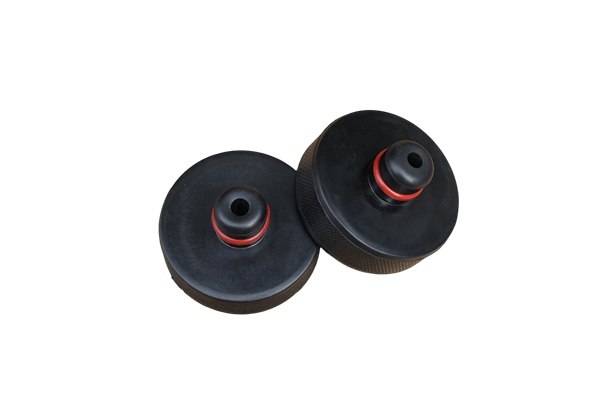

What Is a Jack Rubber Pad?
A Jack Rubber Pad is a molded rubber block or disc placed on top of a car jack saddle. Its main functions include:
·Preventing metal-to-metal contact
·Reducing slipping during lifting
·Protecting pinch welds and frames
·Distributing weight evenly
Compared with bare steel jacks, a Jack Rubber Pad absorbs impact and adapts slightly under pressure, improving control and minimizing damage to vehicle structures.
Why Pad Design Matters in Vehicle Lifting
When lifting a vehicle, the contact point experiences high localized pressure. Without proper support, this pressure can deform metal parts or cause instability.
Pad design directly influences:
·Load distribution
·Friction and grip
·Surface protection
·Alignment with lifting points
Flat and grooved Jack Rubber Pads handle these factors differently, which is why understanding their structure is essential for choosing the right solution for different lifting tasks.
Flat Jack Rubber Pads: Features and Benefits
Flat Jack Rubber Pads have a smooth, level surface. They are commonly used for general-purpose lifting and flat-frame contact areas.
Key characteristics:
·Uniform surface contact – spreads load evenly across the pad.
·Simple geometry – easy positioning on the jack saddle.
·High versatility – suitable for many vehicle types.
·Stable compression behavior – consistent deformation under load.
Flat pads perform best when the vehicle lifting point is already flat and wide. They reduce stress concentration and minimize surface indentation on frames and chassis rails.
Because of their simple design, flat Jack Rubber Pads are efficient to manufacture in large Production volumes, allowing Factory suppliers to maintain consistent dimensions and hardness levels for bulk distribution.
Grooved Jack Rubber Pads: Features and Benefits
Grooved Jack Rubber Pads include slots, channels, or cut patterns designed to fit specific vehicle lifting points, such as pinch weld seams.
Key characteristics:
·Enhanced grip – grooves lock onto metal edges.
·Better alignment – helps center the lifting force.
·Reduced slipping risk – stabilizes uneven surfaces.
·Pinch weld protection – prevents bending of thin metal seams.
Grooved pads are especially useful for modern vehicles with narrow jack points. The groove design absorbs pressure while preventing the seam from collapsing sideways under load.
Advanced Manufacturer tooling and Factory-controlled molding allow consistent groove depth and shape across large Production batches.
Load Distribution and Stability Comparison
One of the biggest differences between flat and grooved Jack Rubber Pads is how they distribute load.
·Flat pads distribute force across a wide surface area, reducing overall pressure per square unit. This improves comfort and minimizes indentation on flat frames.
·Grooved pads focus force along structured channels, increasing grip and positional stability on narrow or uneven lifting points.
In terms of stability:
·Flat pads excel on smooth, flat vehicle contact surfaces.
·Grooved pads excel on pinch welds, rails, and edges where alignment is critical.
Choosing the wrong design may lead to shifting loads, uneven compression, or potential slipping during lifting.
Material and Production Considerations
Regardless of shape, the performance of a Jack Rubber Pad depends heavily on material quality and Production standards.
High-quality pads use engineered rubber compounds that balance:
·Compression strength
·Elastic recovery
·Abrasion resistance
·Temperature tolerance
During Factory Production, pads are molded under controlled pressure and temperature to ensure consistent hardness and durability.
A professional Manufacturer also tests for:
·Load-bearing stability
·Rebound behavior
·Surface friction performance
·Long-term deformation resistance
These processes ensure that flat and grooved Jack Rubber Pads perform reliably even under repeated heavy lifting cycles.
Applications in Different Lifting Scenarios
Both pad styles serve different operational needs.
Flat Jack Rubber Pads are ideal for:
·Frame rail lifting
·Wide contact surfaces
·Garage floor jacks
·General maintenance work
Grooved Jack Rubber Pads are ideal for:
·Pinch weld lifting
·Narrow jack points
·Modern passenger vehicles
·Precision positioning tasks
For workshops and distributors sourcing from Factory Production lines, offering both designs allows coverage across different vehicle types and customer requirements.
Choosing the Right Jack Rubber Pad
When selecting between flat and grooved Jack Rubber Pads, consider:
·Vehicle lifting point structure
·Load capacity requirements
·Jack saddle design
·Frequency of use
·Working environment
If the lifting point is flat, a flat pad delivers uniform support. If the lifting point has seams or edges, a grooved pad ensures better alignment and grip.
Working with a reliable Manufacturer that supports scalable Production and Factory-level quality control ensures long-term consistency and safety for bulk buyers and service providers.
Conclusion: Jack Rubber Pad Design Makes the Difference
The Jack Rubber Pad is a small component with a major impact on vehicle lifting safety. Flat and grooved designs each bring specific advantages in load distribution, grip, and surface protection.
Flat pads provide broad, even support for smooth contact areas, while grooved pads deliver enhanced stability for narrow or structured lifting points. Backed by professional Manufacturer engineering, controlled Production, and Factory-scale supply, both types help improve lifting efficiency, reduce damage risk, and enhance operational reliability.
Choosing the correct Jack Rubber Pad design is not only about shape—it is about safety, performance, and dependable quality that supports every lift with confidence.
References
GB/T 7714:Gu Z, Lei Y, Qian W, et al. An experimental study on the mechanical properties of a high damping rubber bearing with low shape factor[J]. Applied Sciences, 2021, 11(21): 10059.
MLA:Gu, Zhenyuan, et al. "An experimental study on the mechanical properties of a high damping rubber bearing with low shape factor." Applied Sciences 11.21 (2021): 10059.
APA:Gu, Z., Lei, Y., Qian, W., Xiang, Z., Hao, F., & Wang, Y. (2021). An experimental study on the mechanical properties of a high damping rubber bearing with low shape factor. Applied Sciences, 11(21), 10059.