

Why Anti-slip Performance Matters in Vehicle Lifting
Vehicle lifting involves concentrated loads, uneven surfaces, and high safety requirements. Without proper protection, slipping between a jack and the vehicle can cause structural damage or serious safety risks. This is why the Auto Jack Anti-slip Rubber Pad has become an essential accessory in automotive maintenance and repair.
But what actually makes a rubber pad “anti-slip”? The answer goes far beyond simply using rubber. Material formulation, surface texture, pressure behavior, and mechanical interaction all play critical roles in determining real anti-slip performance.
_pad.jpg)
Understanding Slippage During Jacking Operations
Slippage typically occurs when lifting force exceeds frictional resistance at the contact surface. Metal jack saddles contacting painted or coated vehicle underbodies provide limited friction, especially if the surface is smooth or slightly angled.
Even small movements can lead to misalignment, increasing stress on lift points. An effective anti-slip rubber pad minimizes this risk by increasing friction and stabilizing contact under load.
What Is an Auto Jack Anti-slip Rubber Pad?
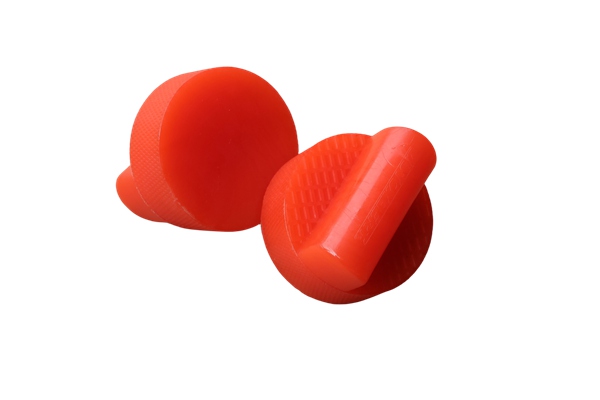
An Auto Jack Anti-slip Rubber Pad is a rubber interface placed between the jack saddle and the vehicle lift point. Its function is to enhance grip, distribute load, and reduce movement during lifting.
These pads are commonly used with floor jacks and workshop lifting systems, especially in environments where stability and surface protection are critical.
Material Composition: The Foundation of Grip
The core factor behind anti-slip performance is material formulation. Not all rubber compounds behave the same under pressure.
High-quality rubber pads use elastomer blends designed to:
·Maintain elasticity under heavy load
·Resist compression set
·Preserve friction characteristics over repeated use
If the rubber is too soft, it may deform excessively and lose stability. If it is too hard, friction is reduced. The balance between elasticity and hardness defines effective anti-slip behavior.
Surface Texture and Contact Geometry
Surface design plays a crucial role in preventing slip. Smooth rubber surfaces rely only on friction, while textured or grooved surfaces add mechanical interlocking.
Common design features include:
·Cross-groove patterns
·Slot designs matching vehicle lift points
·Textured or matte surfaces
These features help channel load evenly and resist lateral movement during lifting.
Friction Coefficient and Load Interaction
Anti-slip performance is not static; it changes with load. As vehicle weight increases, contact pressure rises, affecting friction behavior.
A well-designed rubber pad increases friction proportionally with load, preventing sudden sliding. This controlled interaction is essential for maintaining stability throughout the lifting process.
Load Distribution and Pressure Control
Another reason a rubber pad becomes truly anti-slip is its ability to distribute load. Concentrated pressure on a narrow area can exceed friction limits and cause localized slipping.
By spreading force over a wider contact area, the pad reduces peak stress and improves overall grip. This also protects vehicle underbody components from deformation.
Resistance to Environmental Factors
Oil, dust, moisture, and temperature changes can significantly affect friction. A true anti-slip rubber pad maintains performance despite these variables.
Advanced rubber compounds are formulated to resist:
·Oil contamination
·Surface hardening
·Loss of elasticity in cold or hot conditions
Environmental resistance ensures consistent grip in real-world workshop conditions.
Dimensional Stability Under Repeated Use
Repeated lifting cycles can degrade poorly designed pads. Compression fatigue, cracking, or surface glazing reduces anti-slip effectiveness over time.
A reliable Auto Jack Anti-slip Rubber Pad maintains its shape and surface integrity after repeated loading. Dimensional stability is a key indicator of long-term performance.
Manufacturing Consistency and Quality Control
Anti-slip performance also depends on consistency. From a manufacturer perspective, controlled production processes ensure uniform hardness, surface texture, and dimensional accuracy across each pad.
This consistency is especially important in bulk supply scenarios where predictable performance is required across large quantities.
Safety Benefits Beyond Slip Prevention
While anti-slip performance is the primary function, rubber pads also contribute to overall safety by absorbing vibration and reducing sudden load shifts.
This added stability benefits both the vehicle and the operator, reducing the likelihood of accidents during lifting operations.
How to Identify a Truly Anti-slip Rubber Pad
When evaluating a pad, consider:
·Material hardness balance
·Surface texture effectiveness
·Load rating suitability
·Resistance to oil and wear
A pad that performs well across all these factors can be considered genuinely anti-slip.
Conclusion: What Truly Makes a Rubber Pad Anti-slip?
A rubber pad becomes truly anti-slip when material science, surface design, friction behavior, and load distribution work together. The Auto Jack Anti-slip Rubber Pad is not just rubber—it is a carefully engineered interface that enhances stability, protects vehicle structures, and improves lifting safety.
By understanding what drives anti-slip performance, users can make informed choices and ensure safer, more reliable vehicle lifting over the long term.
References
GB/T 7714:Bhushan B, Ko P L. Introduction to tribology[J]. Appl. Mech. Rev., 2003, 56(1): B6-B7.
MLA:Bhushan, Bharat, and Pak Lim Ko. "Introduction to tribology." Appl. Mech. Rev. 56.1 (2003): B6-B7.
APA:Bhushan, B., & Ko, P. L. (2003). Introduction to tribology. Appl. Mech. Rev., 56(1), B6-B7.