

A Jack Rubber Pad may look like a small accessory, but it plays a critical role in vehicle lifting safety. For first-time buyers, choosing the right pad can prevent costly frame damage, slipping accidents, and premature wear.
As a direct Manufacturer with controlled Production processes and stable bulk supply capability, we understand that quality differences are not always visible at first glance. This checklist will help you make an informed purchasing decision.
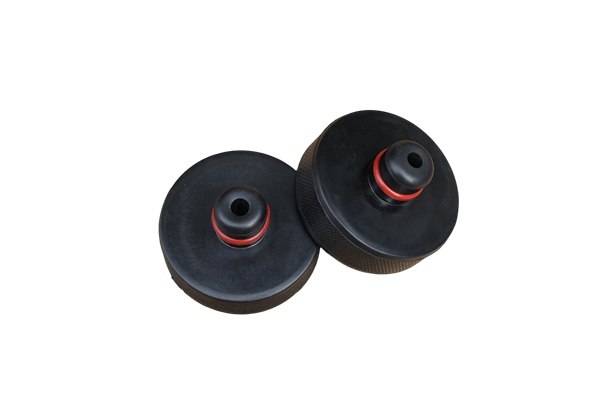

1. Confirm Vehicle Compatibility
The first step is ensuring your Jack Rubber Pad matches your vehicle’s lift points.
Key measurements to verify:
·Slot width (for pinch weld designs)
·Slot depth
·Pad diameter
·Overall thickness
Many first-time users assume “universal” means perfect fit. In reality, slight dimensional mismatches can reduce stability or cause uneven load distribution.
Before purchasing, measure your jack saddle and vehicle lift point carefully.
2. Check Load Capacity and Compression Resistance
A Jack Rubber Pad must support the weight of your vehicle without excessive deformation.
Look for:
·High-density rubber construction
·Balanced Shore A hardness
·Structural compression resistance
If the rubber is too soft, it may flatten excessively under load. If it is too hard, it may not provide adequate grip or shock absorption.
For heavier vehicles such as SUVs, vans, or light trucks, selecting a pad engineered for higher load tolerance is especially important.
3. Evaluate Material Quality
Not all rubber compounds perform the same.
Common material options include:
·Natural rubber (high elasticity)
·Nitrile rubber (oil resistance)
·EPDM rubber (weather resistance)
Low-quality rubber may crack, split, or harden after repeated use. A reliable Manufacturer ensures consistent compound formulation through standardized Production processes.
For outdoor or workshop environments exposed to oil and temperature changes, material selection becomes even more critical.
4. Inspect Surface Design for Grip and Stability
Surface texture impacts lifting safety.
A quality Jack Rubber Pad often includes:
·Anti-slip surface texture
·Reinforced slot edges
·Balanced contact area
Smooth or poorly molded pads may shift under load, increasing risk. Always inspect product photos or request detailed specifications when purchasing in bulk.
5. Consider Durability for Long-Term Use
If you only lift a vehicle occasionally, a standard pad may suffice. However, for:
·Tire service shops
·Fleet maintenance centers
·Professional garages
durability becomes essential.
Repeated compression can cause rubber fatigue. Choosing a product manufactured with consistent curing control and density uniformity ensures longer service life.
Professional Production standards directly influence long-term reliability.
6. Verify Dimensional Tolerance
Precision matters more than many first-time buyers realize.
Inconsistent molding can result in:
·Uneven thickness
·Off-center slots
·Warped surfaces
When purchasing from a direct Manufacturer, confirm that quality inspection standards are in place. Stable Production systems typically include dimensional verification to ensure batch consistency.
7. Evaluate Bulk Supply Stability
If you are a distributor or workshop sourcing multiple units, supply consistency is critical.
Look for:
·Scalable Production capacity
·Reliable bulk supply logistics
·Stable material sourcing
A dependable Manufacturer can support both small trial orders and large-volume procurement without compromising quality.
8. Avoid Overpaying for Branding Alone
Branding does not always equal performance. Instead of focusing on packaging, concentrate on:
·Material density
·Dimensional precision
·Load rating
·Manufacturing consistency
A well-produced Jack Rubber Pad from a specialized Manufacturer often offers better value than heavily marketed alternatives.
9. Safety Should Be the Top Priority
Vehicle lifting involves real risk. A damaged chassis or slipping jack can result in serious injury.
Never compromise on:
·Fit accuracy
·Rubber integrity
·Structural stability
Even for home mechanics, investing in a reliable Jack Rubber Pad improves safety and protects your vehicle’s underbody.
10. Request Technical Specifications Before Purchase
Professional suppliers should be able to provide:
·Material type
·Shore hardness
·Load recommendation
·Dimensions
·Production batch consistency
If these details are unavailable, consider it a warning sign.
Final Thoughts
Buying a Jack Rubber Pad for the first time may seem simple, but careful evaluation ensures long-term safety and durability. Focus on compatibility, load capacity, material quality, and manufacturing consistency.
Choosing a direct Manufacturer with controlled Production systems and reliable bulk supply capability provides peace of mind—whether you are an individual user, workshop operator, or distributor.
A small investment in the right Jack Rubber Pad protects your vehicle, enhances lifting stability, and ensures dependable performance for years to come.
References
GB/T 7714:Callister Jr W D, Rethwisch D G. Materials science and engineering: an introduction[M]. John wiley & sons, 2020.
MLA:Callister Jr, William D., and David G. Rethwisch. Materials science and engineering: an introduction. John wiley & sons, 2020.
APA:Callister Jr, W. D., & Rethwisch, D. G. (2020). Materials science and engineering: an introduction. John wiley & sons.